

At HAIR MAFIA, we believe the best hair extensions aren’t determined by which method happens to be the most popular. They’re determined by your individual hair.
Hair density, strand thickness, hair condition, lifestyle, desired length, maintenance preferences and styling habits all need to be considered before choosing an extension method.
For someone with fine or thin hair, that assessment becomes especially important.
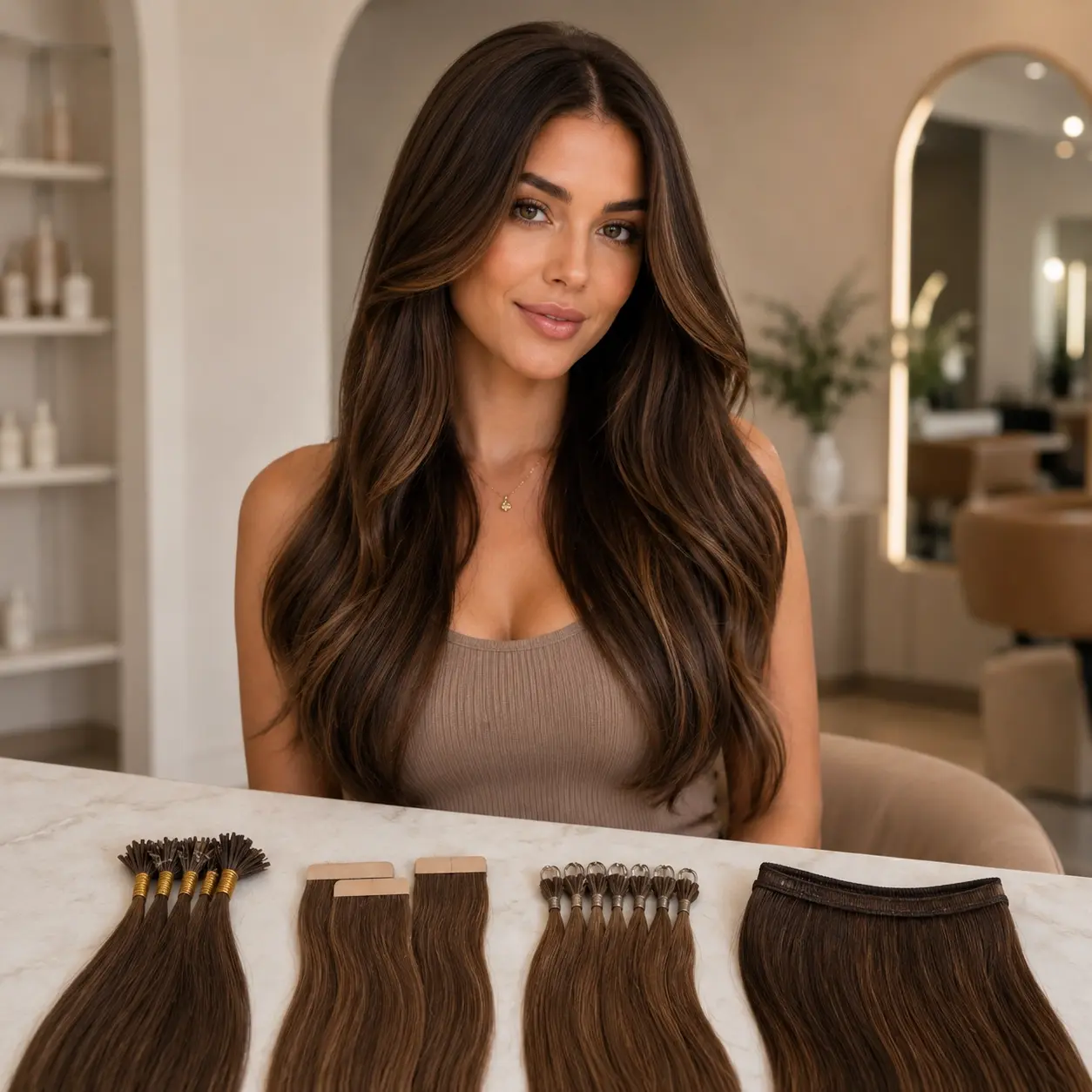
In this guide, we’ll compare some of the most popular professional hair extension methods—including Nano Bead, K-Tip, Tape-In and Weft extensions—and explain what to consider when deciding which method may be right for you.
Can You Get Hair Extensions If You Have Fine or Thin Hair?
In many cases, yes.
Hair extensions can be an excellent way to add volume, density and length to fine hair, provided your natural hair is healthy enough for extensions and the appropriate method, weight and amount of hair are selected.
In fact, clients with fine hair don’t always need a dramatic transformation.
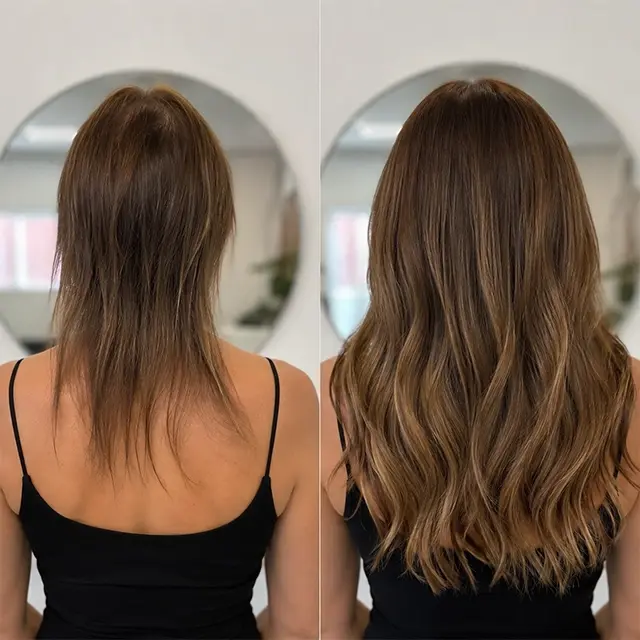
Sometimes the goal is simply to make the ends appear fuller, add density around the sides, create a stronger perimeter, or give naturally fine hair more body.
The key is personalization.
Someone with thick hair may be able to comfortably support considerably more extension hair than someone with delicate, low-density hair. Trying to use the same amount of extension hair on both clients doesn’t necessarily create a better result.
With fine hair, more isn’t always better.
A successful transformation should be designed around what your natural hair can comfortably support.
Fine Hair vs. Thin Hair: What’s the Difference?
Although people often use the words fine and thin interchangeably, they actually describe two different characteristics.
Fine hair refers primarily to the diameter of each individual strand. Someone can have very fine individual strands but still have a large number of hairs on their scalp.
Thin or low-density hair generally refers to having fewer strands of hair within a particular area.
You can therefore have:
- Fine hair with relatively high density
- Fine hair with low density
- Medium or coarse hair with low density
- Different densities in different areas of your head
Why does this matter?
Because choosing hair extensions should involve more than looking at your hair length.
A professional extension consultation should consider both the strength of the individual strands and the overall density of the hair.
What Makes a Hair Extension Method Good for Fine Hair?
When choosing extensions for fine hair, there are several factors we pay particular attention to.
1. Weight
Fine natural hair should not be expected to support an excessive amount of extension hair.
The amount and distribution of added hair should be customized according to the client’s natural density.
2. Attachment Size
Fine hair can make extension attachment points easier to see.
Smaller or strategically positioned attachments may therefore be useful, particularly around areas where the hair naturally separates or where you frequently wear it up.
3. Placement
Placement can be just as important as the extension method itself.
Extensions need to be positioned so your natural hair falls over the attachment points and creates a seamless blend.
The hairline, temples and areas around the part can be especially delicate, so these areas require careful consideration.
4. Distribution
Instead of concentrating too much additional weight in one area, a stylist can design the installation to distribute the extensions appropriately throughout the hair.
5. Your Lifestyle
Do you wear your hair in a ponytail every day?
Do you exercise frequently?
Do you prefer very low-maintenance hair?
How often are you comfortable returning to the salon?
All of these questions can affect which extension system is most appropriate.
Nano Bead Hair Extensions for Fine Hair
Nano Bead extensions are often considered when clients want small, discreet attachment points.
Individual strands of extension hair are attached to small sections of natural hair using tiny beads. Because the attachment points are small, they can be strategically placed throughout the hair to help create a natural-looking result.
Why Nano Beads Can Work Well for Fine Hair
One of the biggest attractions of Nano Bead extensions is their discreet size.
For the right candidate, smaller attachment points can be helpful when natural hair doesn’t provide as much density to conceal larger bonds.
Nano Beads also allow stylists to customize placement and the amount of hair used throughout different areas of the head.
That flexibility can be valuable with fine hair.
For example, a client may need more density through the back while requiring a much lighter application toward the sides.
Nano Beads May Be Right for You If:
- Your hair is fine but healthy enough to support extensions
- You want discreet attachment points
- You frequently wear your hair up
- You want individual extension placement
- You are comfortable following a regular maintenance schedule
However, Nano Beads are not automatically the best choice for every person with fine hair. Natural density, hair condition and the amount of weight attached to each section still matter.
K-Tip Hair Extensions for Fine Hair
K-Tip extensions—sometimes called keratin bond or fusion extensions—use individual extension strands attached to small sections of natural hair.
One reason many clients love K-Tips is the amount of movement and placement flexibility they can provide.
Rather than installing hair in larger continuous sections, individual bonds allow the stylist to customize the extension pattern around the client’s natural hair.
Why K-Tips Can Be a Good Option
When properly selected and installed on an appropriate candidate, K-Tips can create a highly customized transformation.
Individual placement means your stylist can control where additional density is needed and where less hair should be used.
This can be particularly useful when the goal isn’t simply extreme length.
For example, K-Tips can be used to create:
- Fuller-looking sides
- More density through the ends
- Additional length
- Strategic volume
- A natural, flowing blend
They can also provide excellent movement because the extension strands move individually rather than as one large panel.
K-Tips May Be Right for You If:
- You want very natural movement
- You want a highly customized installation
- You wear different hairstyles
- Your natural hair has sufficient strength and density
- You are comfortable with the maintenance requirements of professional extensions
For very fragile or extremely sparse hair, however, a stylist may recommend another approach—or advise against extensions entirely.
Tape-In Hair Extensions for Fine Hair
Tape-In extensions remain one of the best-known professional hair extension systems.
Rather than attaching individual strands, sections of extension hair are applied using thin adhesive tabs.
One advantage is that Tape-Ins can add noticeable volume relatively quickly.
Because the attachment lies relatively flat against the head, Tape-Ins can also feel streamlined when properly installed.
Why Tape-Ins Can Work for Fine Hair
For the right client, Tape-Ins can create beautiful fullness without requiring hundreds of individual attachment points.
They can be especially useful when the goal is:
- Fuller ends
- Increased density
- Moderate length
- A relatively quick transformation
However, placement is extremely important.
Fine hair may not provide enough coverage in every area to conceal a wider tape attachment, particularly near the hairline or part.
Your stylist therefore needs to determine where Tape-Ins can be positioned discreetly.
Tape-Ins May Be Right for You If:
- You primarily want volume and moderate length
- Your hair provides enough coverage to conceal the tapes
- You like a flatter attachment
- You want an efficient salon installation
- You’re willing to follow professional maintenance recommendations
What About Weft Hair Extensions?
Weft extensions can create dramatic volume and length and are extremely popular for hair transformations.
A weft consists of hair attached along a continuous seam rather than individual strands.
For clients with medium-to-thick hair and sufficient density, wefts can produce beautiful, full results.
For someone with very fine or low-density hair, however, the amount of hair, placement and weight become particularly important considerations.
A full installation that works beautifully on thick hair may not be appropriate for a client with significantly finer hair.
That doesn’t necessarily mean someone with fine hair can never wear a weft.
It means the decision needs to be made based on the individual’s natural hair rather than simply choosing a method because it’s trending.
Nano Bead vs. K-Tip vs. Tape-In vs. Weft for Fine Hair
So which method is best?
There isn’t one universal answer.
Here’s a simple way to think about the different options:
| Method | Potential Advantage | Often Considered For |
| Nano Bead | Very small attachment points | Discreet individual placement |
| K-Tip | Individual bonds and natural movement | Highly customized transformations |
| Tape-In | Flat attachment and efficient installation | Volume and moderate length |
| Weft | Significant volume and density | Clients with sufficient natural density |
The best extension system is ultimately the one that works with your hair—not against it.
Will Hair Extensions Damage Fine Hair?
Hair extensions place additional load on natural hair, so no professional should promise that extensions are completely risk-free.
Repeated or excessive tension on hair follicles can contribute to a condition known as traction alopecia. Dermatology organizations specifically identify hair extensions and other tight hairstyles as potential sources of traction when they place excessive or prolonged pulling forces on natural hair.
That makes proper consultation, installation and maintenance particularly important for people with fine or fragile hair.
Pain should never be treated as a normal part of having extensions. The American Academy of Dermatology advises that if extensions or another hairstyle hurt or feel excessively tight, the tension should be reduced.
You should also tell your stylist if you experience ongoing:
- Pain or tenderness
- Excessive pulling
- Persistent scalp irritation
- Unusual breakage
- Increasing thinning around attachment areas
If you are experiencing active or unexplained hair loss, significant scalp problems, or very fragile hair, speak with an appropriate healthcare professional before considering extensions.
The Importance of Hair Quality for Fine Hair
The installation method is only half of the equation.
Hair quality matters too.
HAIR MAFIA uses 100% Remy human hair extensions, designed to provide softness, natural movement and a realistic blend with your own hair.
Remy hair is especially valuable when you’re trying to create a natural-looking transformation rather than an obvious difference between your own hair and the extensions.
The goal should be for someone to notice that your hair looks incredible—not to immediately notice that you’re wearing extensions.
How Much Hair Do You Need for Fine Hair?
This is another area where customization matters.
A client who wants dramatically longer hair may need a different amount than someone whose only goal is to make fine ends look fuller.
For fine-haired clients, we often think in terms of the desired result first:
Volume Only
If you’re happy with your current length but wish your hair looked fuller, you may need a relatively subtle transformation.
Adding carefully placed density can make the perimeter appear fuller without dramatically changing your overall hairstyle.
Volume + Moderate Length
If you want both additional fullness and some extra length, more extension hair may be necessary to create a seamless transition between your natural hair and the extensions.
Major Length Transformation
Taking fine, shorter hair to significantly longer hair requires careful blending.
Simply adding extremely long extensions without enough supporting density can make the difference between the natural hair and extensions more obvious.
This is why an in-person consultation is so valuable.
What Length Is Best for Fine Hair?
Longer isn’t automatically better.
Very long extensions naturally add more hair and more weight. For someone with fine hair, a slightly shorter, fuller transformation may sometimes look more luxurious than trying to achieve maximum length.
The ideal extension length should take into account:
- Your starting length
- Natural density
- Hair condition
- Desired style
- Amount of extension hair required
- Your lifestyle
- How much maintenance you’re comfortable with
At HAIR MAFIA, the goal is not simply to give you the longest hair possible.
It’s to create the best-looking result for your hair.
How to Care for Fine Hair With Extensions
Aftercare is particularly important when your natural hair is fine.
Your stylist should give you instructions specific to your extension method, but good habits generally include being gentle when brushing, avoiding unnecessary pulling at attachment points, keeping your hair properly detangled and attending recommended maintenance appointments.
Avoid repeatedly wearing extremely tight ponytails or styles that place additional tension on the scalp.
And don’t ignore discomfort.
Your extensions should feel like part of your hair—not something constantly pulling against it.
Professional maintenance also gives your stylist an opportunity to check how your natural hair and scalp are responding to the extensions.
What Are the Best Extensions for Very Thin Hair?
This question deserves a careful answer.
If your hair is simply naturally fine or lower-density but otherwise healthy, professional extensions may be an option.
If you’re experiencing significant thinning, unexplained shedding, bald patches or active hair loss, extensions may not be appropriate.
Hair extensions can place additional tension on existing hair, and prolonged traction can contribute to further hair loss in susceptible areas.
In those situations, the priority should be understanding why your hair is thinning.
A dermatologist or other qualified healthcare professional can help evaluate unexplained hair loss before you consider an extension service.
So, Which Hair Extensions Are Best for Fine Hair?
For many clients, Nano Beads, K-Tips or Tape-Ins may all be worth considering. Wefts may also be an option when there is sufficient natural density to support them.
But choosing based solely on the name of the method misses the most important part of the process.
The real question isn’t:
“What is the best type of hair extension?”
It’s:
“What is the best type of hair extension for my hair?”
Two people can walk into a salon with seemingly similar fine hair and leave with completely different extension plans.
One may be an excellent candidate for Nano Beads.
Another may achieve a better result with K-Tips.
Someone primarily looking for fullness may prefer Tape-Ins.
And another client may be advised to strengthen their natural hair or investigate active thinning before getting extensions at all.
That’s exactly why professional consultation matters.
Find the Right Hair Extensions for Your Hair
At HAIR MAFIA, we created our extension line around a simple idea: premium hair extensions should offer quality, flexibility and personalization.
HAIR MAFIA is a line of ethically sourced, 100% Remy human hair extensions available exclusively in-salon at Define Hair Studio in Toronto. Our professional extension options include K-Tip, Nano Bead, Weft and Tape-In extensions, allowing the method to be selected according to the client’s hair, goals and lifestyle rather than forcing every client into the same system.
If you have fine or thin hair and aren’t sure which extension method is right for you, start with a professional consultation.
We’ll look at your natural hair, discuss the result you’re hoping to achieve, consider your lifestyle and maintenance preferences, and recommend an extension plan designed specifically for you.
Because great hair extensions shouldn’t just look beautiful on installation day.
They should look like they belong to you.
Frequently Asked Questions
What type of hair extensions are best for fine hair?
There is no single method that is best for everyone. Nano Bead, K-Tip and Tape-In extensions can all be considered for fine hair depending on natural density, hair condition, desired result and lifestyle. A professional consultation is the best way to determine the appropriate method.
Can thin hair support hair extensions?
Some people with naturally thin or low-density hair can wear extensions successfully, but the amount and weight of added hair need to be carefully considered. Very fragile hair or active hair loss may make extensions unsuitable.
Are Nano Bead extensions good for fine hair?
Nano Beads can be an option because their small attachment points allow individualized placement. However, suitability depends on the strength and density of your natural hair.
Are K-Tip extensions good for fine hair?
K-Tips can provide highly customized placement and natural movement. The size, weight and placement of each bond should be selected according to the client’s natural hair.
Are Tape-In extensions good for fine hair?
They can be. Tape-Ins have relatively flat attachment points and can add significant fullness, but fine hair must provide sufficient coverage to conceal the tapes.
Can hair extensions make fine hair look thicker?
Yes. Extensions don’t have to be used solely for dramatic length. Strategically placed extensions can add density through the sides and ends, creating the appearance of fuller, thicker hair.
Can extensions damage fine hair?
Extensions can contribute to breakage or traction-related hair loss when excessive tension or weight is placed on natural hair. Proper candidate selection, professional installation, appropriate weight and ongoing maintenance are particularly important for fine hair.
Where can I get HAIR MAFIA extensions in Toronto?
HAIR MAFIA extensions are available exclusively in-salon at Define Hair Studio in Toronto. A consultation can help determine the appropriate extension method, colour, length and amount of hair for your desired result.