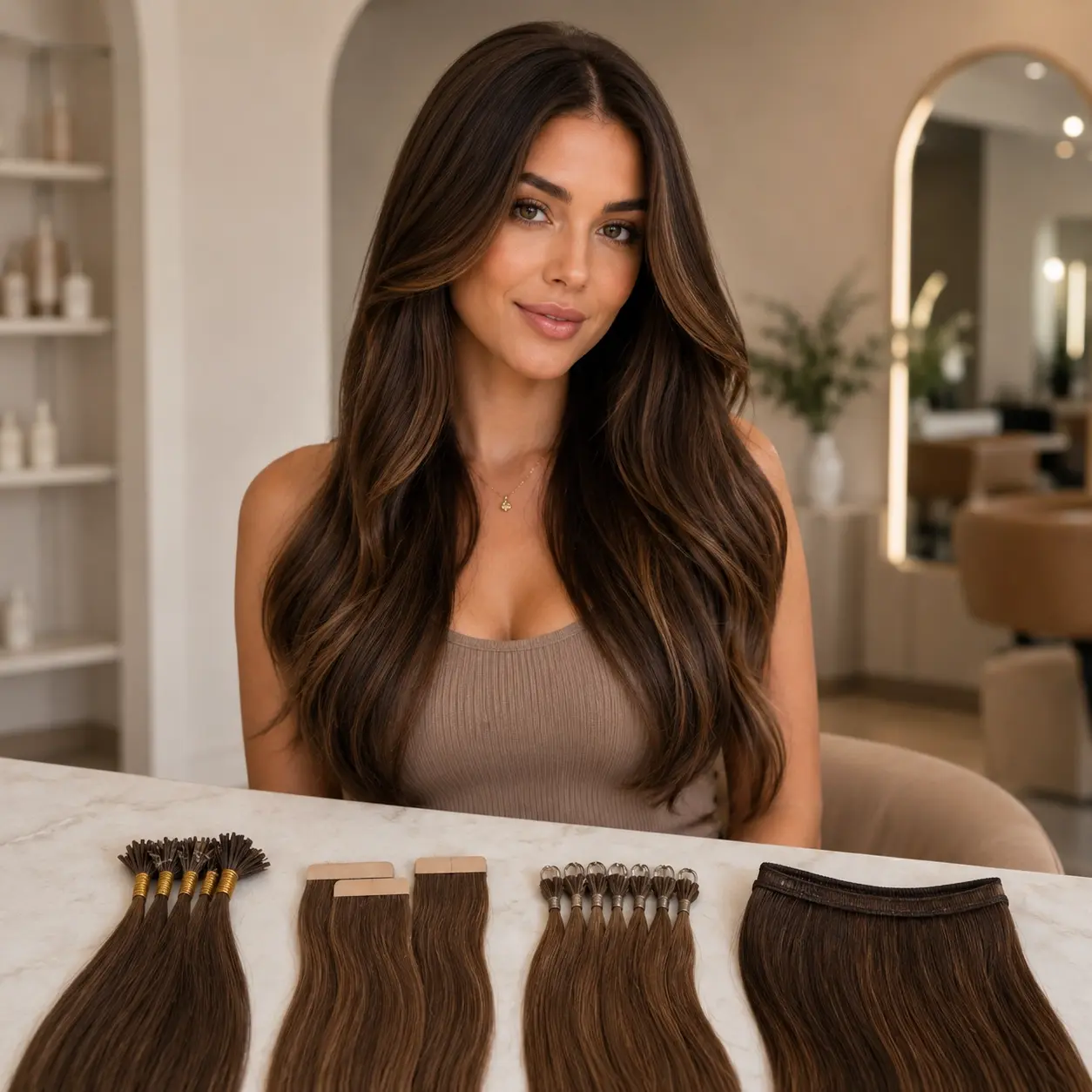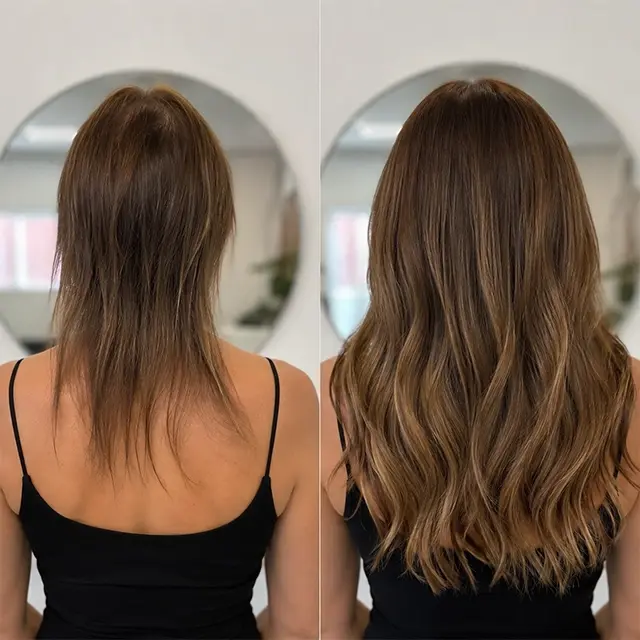


At HAIR MAFIA, we don’t believe there is one extension method that’s universally “the best.”
The best method is the one that works with your natural hair, your desired result and the way you actually live with your hair every day.
Someone with fine hair looking for subtle fullness may need something completely different from someone with thick hair who wants dramatic length. Someone who wears a high ponytail several times a week may have different priorities than someone who almost always wears their hair down.
That’s why choosing extensions should start with understanding the differences.
Here’s our complete guide to K-Tip vs. Tape-In vs. Nano Bead vs. Weft hair extensions and how to decide which option could be right for you.
Quick Comparison: K-Tip vs. Tape-In vs. Nano Bead vs. Weft
Before we look at each method individually, here’s a simple overview.
| Extension Method | Key Advantage | Attachment Style | Best Considered For |
| K-Tip | Natural movement and customization | Individual keratin bonds | Customized length and volume |
| Nano Bead | Very small attachment points | Individual strands with tiny beads | Discreet placement and flexibility |
| Tape-In | Flat attachment and efficient installation | Adhesive tabs | Volume and moderate-to-significant length |
| Weft | Significant density and fullness | Continuous weft/row | Fuller transformations and clients with adequate density |
Keep in mind that this is only a general comparison.
Your natural hair density, condition, haircut, length and lifestyle should ultimately determine which method is most appropriate.
What Are K-Tip Hair Extensions?
K-Tip extensions, also known as keratin-tip or fusion extensions, consist of individual strands of extension hair with a keratin-based bond at the top.
During professional installation, individual K-Tip strands are attached to carefully selected sections of natural hair.
One of the biggest advantages of K-Tips is freedom of movement.
Because the extensions are installed as individual strands rather than large panels or rows, the hair can move naturally and the stylist has significant control over placement.
Advantages of K-Tip Extensions
K-Tips can be especially appealing when you’re looking for:
- Natural movement
- Individual strand placement
- A highly customized installation
- Discreet attachment points
- Added length and volume
- Flexibility when styling your hair
The stylist can adjust the placement and amount of extension hair according to the density of different areas of your head.
That level of customization can make K-Tips an excellent option for clients who want a transformation that feels integrated into their natural hair.
Who Are K-Tips Best For?
K-Tips may be worth considering if you want natural movement and a highly customized result.
They’re particularly attractive to clients who don’t want their extensions installed in larger continuous sections.
However, suitability depends on the condition and density of your natural hair. Fine or fragile hair requires careful assessment to make sure the amount and weight of the extensions are appropriate.
Things to Consider With K-Tips
K-Tip installations can take longer than some other extension methods because the extensions are applied individually.
They also require proper home care.
As with any professional extension system, brushing technique, styling habits and following your stylist’s maintenance recommendations all matter.
What Are Nano Bead Hair Extensions?
Nano Bead extensions also use an individual strand application, but instead of a keratin bond, the extension is secured using a very small bead.
The tiny attachment is one of the main reasons Nano Beads have become such a popular option.
For appropriate candidates, their small size can make the attachment points very discreet.
Advantages of Nano Bead Extensions
Nano Beads can offer:
- Small, discreet attachment points
- Individual strand movement
- Customized placement
- No adhesive attachment
- Flexibility for different hairstyles
- The ability to reposition extensions during maintenance, depending on the system
Because the strands are installed individually, the stylist can strategically control where additional volume and length are added.
Who Are Nano Beads Best For?
Nano Beads can be a particularly interesting option for clients who prioritize small attachment points and styling flexibility.
They may also be considered for some clients with finer hair because the attachment points are small.
However, “small” doesn’t automatically mean appropriate for every person with fine hair.
The natural hair still needs to be strong enough to support the extension, and the amount of extension hair attached to each section must be carefully considered.
Things to Consider With Nano Beads
Nano Beads require maintenance as your natural hair grows.
The attachments gradually move farther away from the scalp and need to be professionally repositioned according to the schedule recommended by your stylist.
Regular maintenance is an important part of keeping the extensions looking and feeling their best.
What Are Tape-In Hair Extensions?
Tape-In extensions use thin sections of extension hair with adhesive tabs.
Rather than attaching individual extension strands, Tape-Ins create wider sections of additional hair.
When properly installed, the attachment sits relatively flat against the head.
One of their major advantages is that they can create noticeable volume efficiently.
Advantages of Tape-In Extensions
Tape-Ins may offer:
- A relatively flat attachment
- Efficient installation
- Excellent volume
- Natural-looking length
- A streamlined feel against the head
- Reusable extension hair when properly maintained, depending on the product and condition
For clients looking to add fullness throughout the hair, Tape-Ins can create a significant transformation without installing large numbers of individual bonds.
Who Are Tape-Ins Best For?
Tape-Ins may be a good choice for clients looking for volume, length and a relatively quick professional installation.
They can work with different hair types, provided there is sufficient natural hair to conceal the attachment points.
For clients with very fine or low-density hair, placement becomes particularly important.
The stylist needs enough natural hair above the tape to prevent the attachment from becoming visible.
Things to Consider With Tape-Ins
Because Tape-Ins use an adhesive attachment, clients need to follow the specific care instructions provided for the system.
Certain products applied directly around the attachment area can interfere with the adhesive.
Tape placement can also affect styling flexibility, particularly if you frequently wear certain high or tightly pulled-back hairstyles.
What Are Weft Hair Extensions?
Weft extensions differ significantly from individual-strand methods.
Instead of attaching separate strands throughout the head, extension hair is constructed along a continuous seam—or weft—and installed in rows.
Wefts can provide a substantial amount of hair, which makes them popular with clients seeking dramatic fullness and length.
Advantages of Weft Extensions
Wefts can be excellent for:
- Significant volume
- Fuller transformations
- Adding considerable length
- Creating density through the back and sides
- Clients with enough natural hair to support and conceal the installation
For someone starting with medium-to-thick hair, a professionally designed weft installation can create a dramatic yet beautifully blended transformation.
Who Are Wefts Best For?
Wefts are often particularly well suited to clients with medium or thicker hair and sufficient natural density.
That doesn’t mean someone with finer hair can never wear a weft. However, the weight, number of rows, placement and natural hair strength need to be carefully evaluated.
A method that works beautifully for someone with thick hair shouldn’t automatically be duplicated on someone with significantly less density.
Things to Consider With Wefts
Because a weft places a larger amount of extension hair along a row, proper weight distribution is important.
Your stylist should determine how many rows—and how much hair—your natural hair can appropriately support.
K-Tip vs. Nano Bead: What’s the Difference?
These two methods are sometimes compared because both involve individual extension strands.
The major difference is how they’re attached.
K-Tips use a keratin-based bond, while Nano Beads use a tiny bead.
Both methods allow the stylist to distribute individual strands throughout the hair and create customized placement.
Choose K-Tips if:
You prioritize natural individual movement, customized placement and the feel of a bonded extension system.
Consider Nano Beads if:
You like individual placement but prefer a bead-based attachment that can be repositioned during maintenance, depending on the extension system.
Neither is automatically superior.
Your natural hair and lifestyle should determine which makes more sense.
K-Tip vs. Tape-In: Which Is Better?
The biggest difference here is individual strands versus wider panels.
K-Tips give the stylist very precise control over individual placement.
Tape-Ins allow larger sections of hair to be added relatively efficiently.
If styling versatility and individualized placement are priorities, K-Tips may have an advantage.
If you’re looking for efficient installation and significant volume, Tape-Ins may be attractive.
Again, there is no universal winner.
Nano Bead vs. Tape-In Extensions
Nano Beads and Tape-Ins create very different experiences.
Nano Beads use individual strands with small attachment points. Tape-Ins use wider, flatter adhesive tabs.
Nano Beads can offer greater individual movement and strategic placement.
Tape-Ins can add noticeable density with fewer attachment sections.
For someone with fine hair, the decision may depend on whether there is enough natural coverage to conceal a tape attachment versus enough strength to appropriately support individual Nano extensions.
Weft vs. K-Tip Hair Extensions
This comparison often comes down to rows versus individual strands.
Wefts can add a considerable amount of hair through strategically placed rows.
K-Tips distribute individual extension strands throughout the installation area.
For clients with thick hair seeking a major transformation, Wefts can be an excellent option.
For clients who prioritize individual movement and highly customized placement, K-Tips may be preferable.
Which Hair Extensions Are Best for Fine Hair?
If you have fine or thin hair, extension selection requires additional care.
The goal should be to add enough hair to create fullness without overwhelming the natural hair.
K-Tips and Nano Beads may be considered because individual placement allows the stylist to customize the distribution of extension hair.
Tape-Ins can also work beautifully for appropriate fine-haired clients, particularly when enough natural hair is available to conceal the attachment.
Wefts may be possible when the natural hair has sufficient strength and density, but weight and placement become especially important.
There is no method that should automatically be prescribed simply because someone says they have “fine hair.”
Fine hair describes strand diameter. Hair density describes how much hair you actually have.
Both need to be considered.
Which Extensions Are Best for Thick Hair?
Clients with naturally thick hair often have different challenges.
Instead of worrying primarily about concealing attachment points, the challenge may be adding enough extension hair to create a seamless blend.
If naturally thick hair is paired with too little extension hair, the natural ends can remain visible and create an obvious separation.
Wefts can be an excellent option for adding substantial density.
K-Tips and Nano Beads can also create beautiful results because additional strands can be strategically distributed throughout the hair.
The correct amount of hair is just as important as the method.
Which Extensions Look the Most Natural?
This is one of the most common questions we hear.
The answer isn’t simply K-Tips, Nano Beads, Tape-Ins or Wefts.
Any of these methods can look natural when they’re appropriate for the client and professionally installed.
Natural-looking extensions depend on several things:
- Hair quality
- Colour matching
- Extension texture
- Proper placement
- Appropriate density
- Attachment concealment
- Cutting and blending
- The skill of the extension professional
Even the most expensive hair won’t look completely natural if the colour, density or cut doesn’t blend with your own hair.
Conversely, a carefully planned installation can make extensions incredibly difficult to detect.
Which Hair Extensions Are Best for Wearing Your Hair Up?
If ponytails, buns and updos are part of your everyday routine, tell your extension stylist during your consultation.
Individual methods such as K-Tips and Nano Beads can offer significant styling flexibility because the attachments can be strategically positioned with movement in mind.
Tape-Ins and Wefts can also accommodate many hairstyles, but row or panel placement needs to account for how you typically style your hair.
This is one reason we always recommend choosing extensions based on your real lifestyle, not just the way you want your hair to look immediately after installation.
Which Extension Method Requires the Least Maintenance?
Every professional hair extension method requires maintenance.
There really isn’t a responsible “install them and forget them” option.
Nano Beads, Tape-Ins and Wefts generally require professional maintenance as the natural hair grows and the attachment points move away from the scalp.
K-Tips follow their own wear and removal schedule rather than simply remaining in the hair indefinitely.
The exact schedule depends on your extension system, natural hair growth, home care and stylist recommendations.
Instead of choosing solely based on which method sounds lowest maintenance, ask yourself:
Which maintenance routine am I realistically willing to follow?
That question often leads to a better decision.
Can Hair Extensions Damage Your Natural Hair?
Any extension system can potentially contribute to breakage or traction-related hair loss if inappropriate weight or excessive tension is placed on the natural hair.
That’s why the quality of the consultation and installation matters just as much as the extension method.
Your extensions shouldn’t feel excessively tight or painful.
A professional should consider the health, strength and density of your natural hair before recommending an installation.
If you’re experiencing active hair loss, significant thinning or unexplained shedding, extensions may not be appropriate until the underlying issue has been assessed by a qualified healthcare professional.
Healthy extension wear begins with respecting the natural hair underneath.
Hair Quality Matters Just as Much as the Method
You can choose the perfect extension method and still be disappointed if the extension hair itself doesn’t look or behave naturally.
At HAIR MAFIA, we use 100% Remy human hair because the quality of the hair plays a major role in the finished result.
Premium human hair should provide natural movement, softness and styling versatility while allowing the extensions to blend convincingly with your own hair.
Colour is equally important.
A truly seamless transformation may require more than simply choosing one shade from a colour ring. Strategic colour matching and blending can help extensions work with highlights, balayage and dimensional hair colour.
The objective isn’t for people to compliment your extensions.
It’s for people to compliment your hair.
So, Which Hair Extension Method Is Best?
Here’s the simplest answer:
There is no single best hair extension method. There is a best method for you.
If you want highly customized individual placement and natural movement, K-Tips may be an excellent choice.
If you want very small individual attachment points and a bead-based system, Nano Beads may be worth considering.
If you want a relatively flat attachment with efficient installation and beautiful volume, Tape-Ins may be a great option.
If you have sufficient natural density and want significant fullness and length, Wefts may be ideal.
But these are starting points—not rules.
Your natural hair density, condition, length, lifestyle, styling habits and desired transformation all need to be considered.
Choosing Your Hair Extensions at HAIR MAFIA
At HAIR MAFIA, we believe hair extensions should be customized to the person wearing them.
Our premium 100% Remy human hair extensions are available in multiple professional application methods, including K-Tip, Nano Bead, Tape-In and Weft extensions, giving extension professionals the flexibility to create a solution based on the client’s individual hair.
Whether you’re looking for subtle fullness, longer hair, more density through the sides or a complete transformation, choosing the right method begins with understanding your natural hair.
That’s why we recommend starting with a professional consultation.
Your hair density can be evaluated, your goals discussed, your colour matched and the extension method, length and amount of hair can be selected specifically for the result you want.
Because the question shouldn’t be:
“Which hair extensions are the most popular?”
It should be:
“Which hair extensions are right for me?”
Frequently Asked Questions
Are K-Tips better than Tape-In extensions?
Neither method is universally better. K-Tips offer individual strand placement and excellent movement, while Tape-Ins use wider, flatter attachment sections and can add volume efficiently. The better option depends on your natural hair and lifestyle.
Are Nano Beads better than K-Tips?
Nano Beads and K-Tips both allow individual placement but use different attachment systems. Nano Beads use tiny beads, while K-Tips use keratin-based bonds. A professional consultation can determine which system is more appropriate for your hair.
Which extensions are best for fine or thin hair?
K-Tips, Nano Beads and Tape-Ins may all be considered for fine hair depending on its strength and density. Wefts may also be appropriate for some clients. The amount, weight and placement of the extension hair are especially important when natural hair is fine or low-density.
Which hair extensions are best for thick hair?
Wefts can provide the substantial density often needed to blend with thick natural hair. K-Tips and Nano Beads can also work extremely well when enough individual extension strands are used to create a seamless blend.
Which extensions are least noticeable?
K-Tips and Nano Beads have small individual attachment points, while Tape-Ins sit relatively flat against the head. Wefts can also be very discreet when properly positioned and covered by sufficient natural hair. The most invisible result depends on correct placement for your individual hair.
Which hair extensions look the most natural?
All four methods can produce natural-looking results. Hair quality, colour matching, placement, density, cutting and blending usually matter more than simply choosing one extension method over another.
How do I know which hair extensions I need?
Start with a professional consultation. Your stylist or extension professional should assess your natural hair density and condition, discuss your desired length and volume, learn how you normally style your hair and recommend an extension method accordingly.